
Predicting Tomorrow by Reading Yesterday: How Data Tells the Future
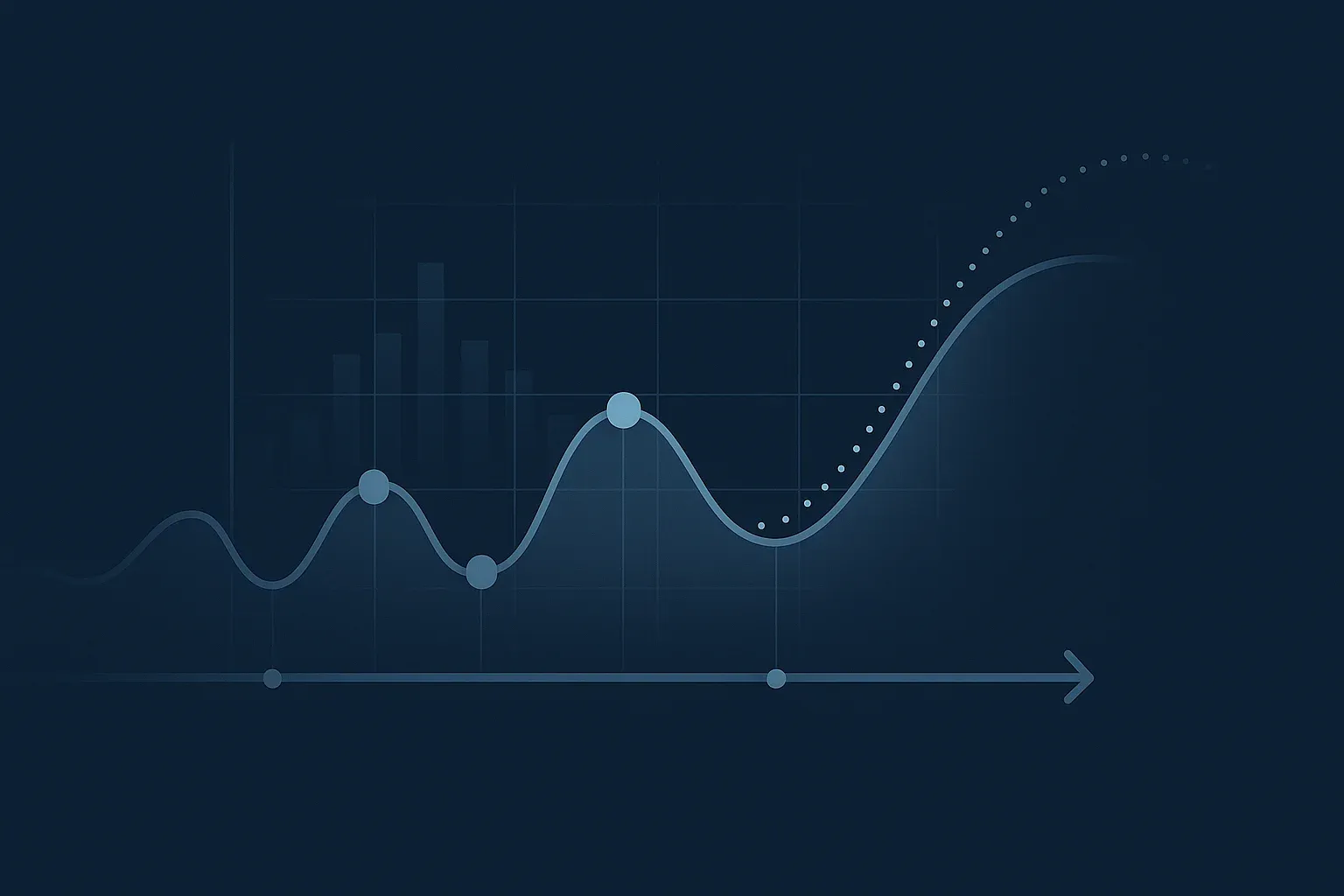
You know how a meteorologist predicts tomorrow's rain by looking at trends from the previous days? Or when an energy company estimates next month's demand based on historical consumption?
Well, that's called time series analysis. Simply put, it means using data collected over time to identify patterns and anticipate what might happen.
Today, time series analysis is a fundamental pillar for many applications: manufacturing, logistics, energy, and even agriculture. And thanks to artificial intelligence, it is becoming one of the most useful tools for making informed decisions.
What Are Time Series and Why Analyze Them?
Imagine a daily sales register for your store: a number every day, day after day. That is a time series. If you look back, you might notice that sales go up in the summer (maybe because you sell ice cream) and go down in the winter.
These movements are called patterns: trends, seasonality (recurring cycles, like seasons or weekends), and sudden variations. Analyzing a time series means discovering these hidden patterns to better understand the past and make more informed decisions for the future.
Why is all this useful? Well, knowing the past gives us predictive power. If I know that every year in July I have 30% more sales, I can prepare with extra inventory. In practice, time series analysis helps companies and organizations predict future trends from historical data, transforming them into strategic insights.
From Statistics to AI: What Has Changed
Early models were statistical: moving averages, regressions, ARIMA. They are great when everything moves with regularity. But the real world doesn't follow perfect patterns.
This is where AI models come into play, like LSTM neural networks, which are capable of memorizing complex sequences. Or Prophet, created by Facebook, which is easier to use but highly effective for business data.
These tools don't just calculate averages: they learn. And the more data they see, the better they predict.
Practical, and Very Concrete, Applications
Okay, theory aside, where do we find these time series analyses in real life? Practically everywhere you need to make predictions based on historical data. Here are a few concrete examples across different sectors:
1. Demand Forecasting
How many sales will there be next month? If you can estimate it accurately, you avoid overstocked warehouses or stockouts. And you save a lot of money.
2. Predictive Maintenance
You can detect a machine that is slowly overheating in time. By analyzing its data over time, you can stop it before it breaks down.
3. Data Anomalies
An anomalous spike in consumption? A strange drop in production? Recognizing them immediately makes the difference between a minor intervention and a major problem.
4. Resource Optimization
Energy, water, raw materials: if you understand how they are used over time, you can cut waste and improve efficiency.
How Red Lynx Works on These Issues
At Red Lynx, we start with a simple question: where can we help you see better over time?
We build custom models for real companies. We analyze the data, organize it, and design algorithms that learn and predict.
A Concrete Example: MaChAwAI
In this European project, we were responsible for analyzing test data on 3D-printed materials. Instead of using slow and expensive laboratory instruments, we built an AI model capable of providing real-time results with the same accuracy.
Faster, more accessible. Even for an SME.
Another Case: OK-ROAD
We collaborated with Anas to monitor the condition of roads. With a mix of computer vision and predictive models, the system detects cracks and damage before they become critical.
This means lower costs, more safety. And timely interventions.
When AIs Collaborate
The real strength lies in integration. Predictive analytics works extremely well with other technologies: computer vision, to read the context, and generative AI, to transform data into clear reports.
A predictive model, for example, can send an automatic (and understandable) alert when something isn't right. You don't need a data scientist to understand what to do: the systems speak clearly.
From Data to Value, Towards a Predictive Future
Looking at historical data is like re-reading a diary. With the right tools, it becomes a compass for making better decisions.
And if you're wondering where to start, the answer is this: you start with your data. And with a chat with those who know how to read it the right way.
Have a project in mind?
We're ready to listen to your ideas and turn them into innovative AI solutions. Contact us for a free consultation.
Contact us now