
Intelligent Robotics: Advanced Automation for Modern Industry
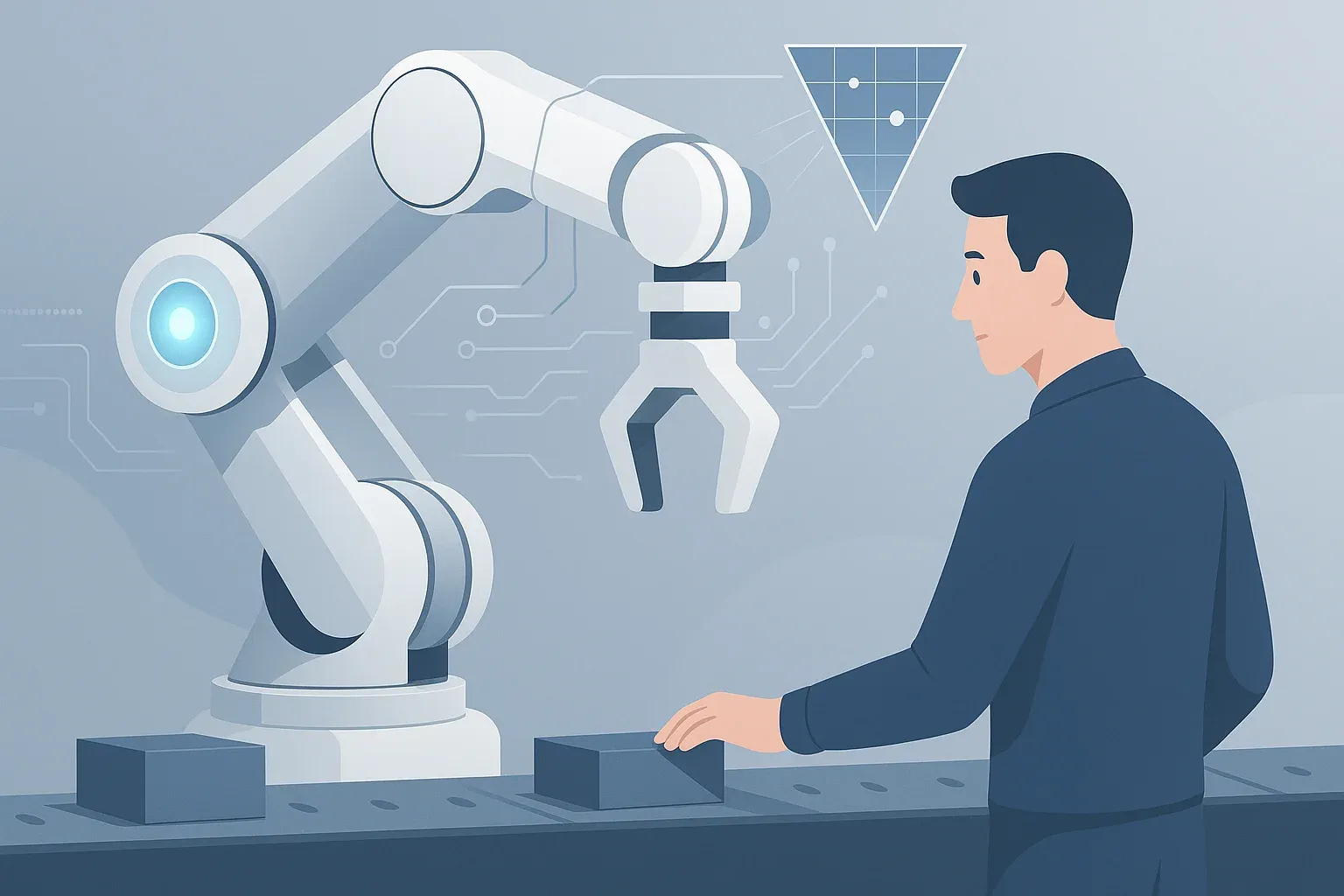
In the warehouse of the future, there are robots that move on their own. They don't take breaks, they don't take the wrong aisle, and they communicate with each other to optimize every movement.
In the factory, instead, there are robotic arms that don't just repeat commands, but learn new tasks by watching human operators. This is not a sci-fi movie.
This is intelligent robotics. And it is already working, silently, in many modern companies. And the interesting thing is that you no longer need to be a big tech company to adopt it.
What Makes It "Intelligent"
The difference is all here: traditional robots do what you tell them to do, in the exact same way, until something changes. Intelligent robots, on the other hand, observe, listen, learn; they have sensors, cameras, vision software, and AI algorithms. They can adapt to dynamic contexts, collaborate with humans, and make decisions (within certain limits) autonomously.
They are called cobots when they work alongside people. They are called AMRs (Autonomous Mobile Robots) when they move on their own. And they all have one thing in common: they make automation more flexible, efficient, and safe. A sort of "upgrade" to traditional robotics: instead of always following the same script, they react to the unexpected and adapt.
Practical Applications of Intelligent Robotics
Let's take the assembly line. Imagine a robotic arm working side-by-side with a worker. It recognizes the position of the human hand, stops if necessary, and improves at the task every week. It's not just about speeding up assembly, but increasing safety and freeing up human resources for higher-value tasks.
Then there are autonomous robots for logistics. Traditional forklifts require an operator. AGVs (Automated Guided Vehicles) and especially AMRs navigate the warehouse on their own, avoiding obstacles, choosing the fastest route, and optimizing internal flow. They can work 24/7 without shifts. And they never forget a destination.
There are also automated inspections. In many industrial plants, sending a technician is risky or expensive. Connected robots, drones, or wheeled units can roam among the machinery, film, and detect abnormal temperatures, vibrations, and sounds. And warn if something is going wrong. All without human intervention.
Finally, robotics in agricultural and autonomous production contexts. Some robotic arms today are capable of recognizing and picking ripe fruit, avoiding unripe ones. Others manage entire production lines autonomously during night shifts. With computer vision and machine learning, these systems learn to distinguish shapes, colors, and situations.
The Benefits, Visible Immediately
More safety, because robots handle dangerous environments, leaving humans with supervisory roles. More efficiency, because they work 24 hours a day, without drops in attention. More flexibility, because you don't need new machines, you just reprogram them. More human value, because people focus on complex tasks while robots handle repetitive ones.
What We Do at Red Lynx
At Red Lynx, intelligent robotics isn't just theory. What we do is easy to explain, but has a massive impact: we design and integrate custom solutions, combining hardware (robots, sensors) and software (AI, computer vision, planning).
We help companies choose the right type of robot (cobot, AGV, AMR), customize the system's intelligence based on the operational context, integrate cameras and 3D vision to give robots "eyes," and design autonomous logic for task management.
We have also worked with autonomous mobile robots for inventory control: a system that moves between shelves at night, checks labels, and compares them with the database. An accessible solution even for SMEs. But always with an eye on real efficiency, not just innovation on paper.
When Vision, AI, and Robotics Meet
Try to imagine a robot that not only moves but sees. And not only sees but understands what is in front of it. This is exactly what happens with the OK-ROAD project: an autonomous vehicle, equipped with computer vision, patrols the roads detecting anomalies.
Potholes, cracks, misplaced signs. It doesn't wait for the damage: it intercepts it before it becomes a serious problem.
And if it works for roads, it works elsewhere too. In a warehouse at night, where a robot can check stock without disturbing anyone. In a greenhouse, where it can monitor plant growth and report diseases.
On a production line, where it observes every phase and flags if something deviates from the norm. This is where the intersection of AI, vision, and robotics becomes truly transformative: observing, understanding, acting. In real-time. And with an intelligence that, for once, shouldn't be feared but leveraged.
Where to Start?
Often, a clear idea, a concrete process, and a pinch of curiosity are enough. You start with a pilot: something small but strategic, that allows you to test the technology in the field. A sort of dress rehearsal.
From there, you measure the results, adjust your aim, and, if it works, you scale. We are right here to accompany you on this journey. Because intelligent robotics doesn't have to be complicated to be useful.
Have a project in mind?
We're ready to listen to your ideas and turn them into innovative AI solutions. Contact us for a free consultation.
Contact us now